AI Consultant vs AI Agency Singapore: Which Do You Actually Need?
Solo AI consultant or full AI agency? For most Singapore SMEs, the answer is not obvious. This guide maps your situation to the right choice — and when a hybrid model wins.
Nick Tung
@nick_tung_ · 16 min read
Published:
Updated:
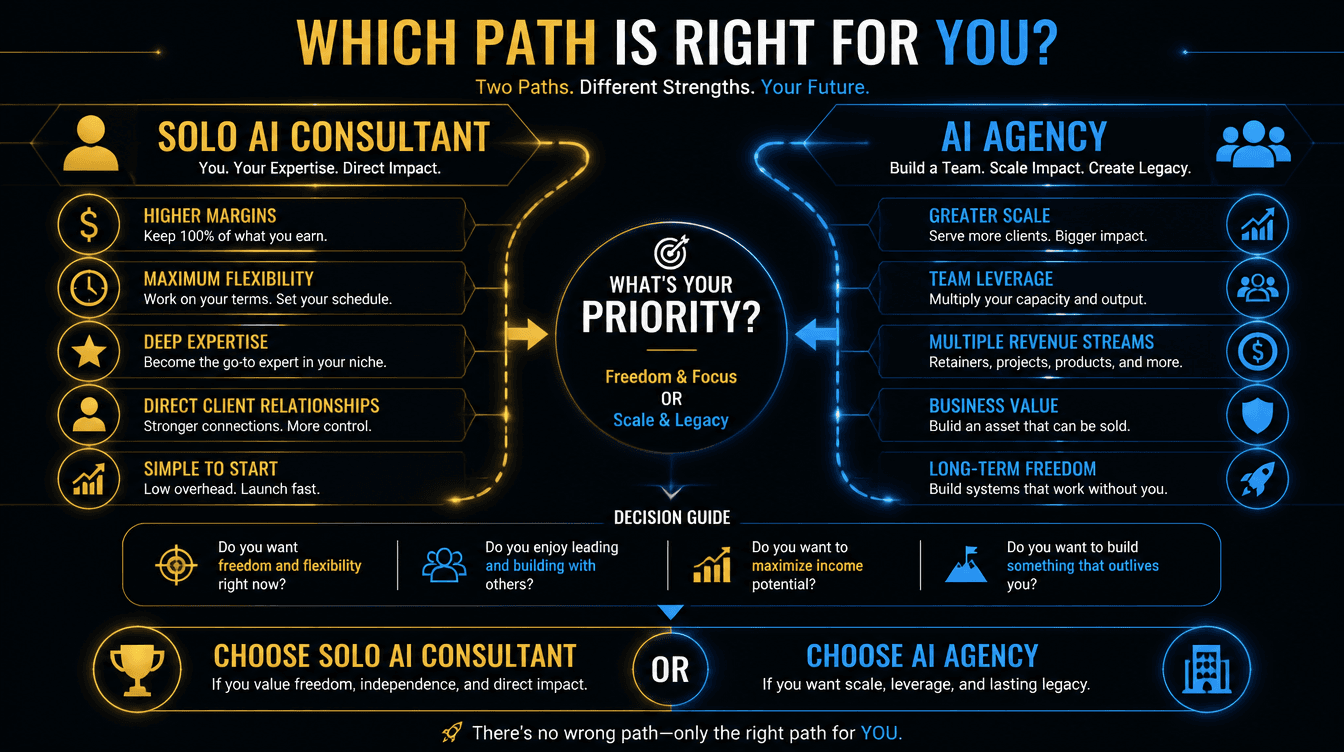
AI consultants and AI agencies are not interchangeable, and choosing the wrong one is one of the most expensive mistakes Singapore SMEs make in their AI adoption journey. This article gives you a clear, practical framework for deciding which option fits your situation, including honest guidance on when a full agency is genuinely the better choice.
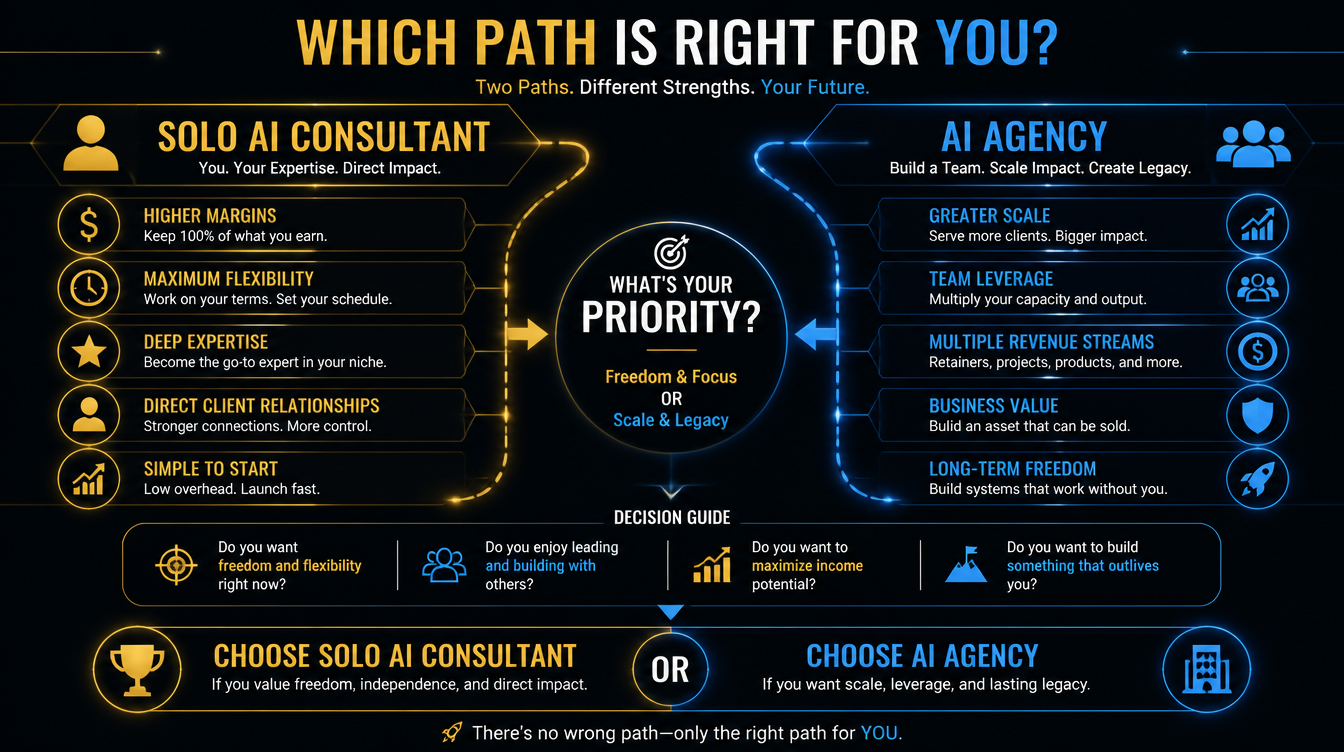
Before we go further: I am a solo AI consultant in Singapore. That means I have skin in this comparison. Which is exactly why I am going to be honest about it, because the businesses that come to me when they should have gone to an agency end up frustrated, and vice versa. Getting this decision right matters more than getting my fee.
The reality is that most Singapore SMEs in the 10 to 100 employee range are better served by a PMC-certified solo consultant with a strong specialist network than by a full-service AI agency. But "most" is not "all." This article will tell you which bucket you fall into.
Defining the Difference: What a Solo AI Consultant Does vs. What an AI Agency Provides
A solo AI consultant is a single experienced practitioner who takes full ownership of your AI strategy, implementation roadmap, and often the initial build. An AI agency is a structured team (typically combining project managers, prompt engineers, data engineers, UX designers, and developers) working under one commercial entity.
The difference is not just headcount. It is about how accountability, expertise, and commercial incentives are structured.
What a solo AI consultant actually does in practice:
A solo consultant diagnoses your business first. Before recommending any tool or platform, they interview your team, map your existing workflows, and identify where AI will create genuine leverage versus where it will just add complexity. The engagement typically moves through three phases: discovery and roadmap (2 to 4 weeks), implementation or vendor oversight (4 to 12 weeks), and knowledge transfer (ongoing or capped). Because the consultant is the only person in the room, there is no information loss between the person who understood your business and the person who builds the solution. The advice and the implementation come from the same brain.
In Singapore, PMC-certified AI consultants (certified under the IMDA-recognised Professional Membership Certification framework) are also qualified to co-sign EnterpriseSG EDG grant applications as the external consultant of record. This is not a minor detail. It determines grant eligibility.
What an AI agency actually does in practice:
An AI agency brings a team. Depending on their model, that might mean a discovery call with a business development manager who hands off to a project manager who briefs a technical team you never meet. Or it might mean an integrated team where the same three people handle strategy, build, and QA. The quality varies enormously across Singapore's AI agency market.
Agencies are structured for repeatability. They have productised offerings, standard tech stacks, and documented processes. That is a strength when your needs fit their standard mould, and a weakness when they do not. When you engage an agency, you are buying their system. When you engage a solo consultant, you are buying their judgment.
The commercial incentive gap matters too. A solo consultant's incentive is to solve your problem and earn a referral. An agency's incentive is to retain your account and grow it. Neither is unethical, but they pull in different directions.
When a Solo AI Consultant Is the Right Choice for Singapore SMEs
A PMC-certified solo AI consultant is the right choice when you are in early-stage AI adoption, when your budget is constrained, when you need strategic clarity before technical execution, or when the scope fits within what one experienced person can manage end-to-end.
Let me be specific about each scenario.
You need a roadmap before you need an army.
The single most common mistake Singapore SMEs make is trying to implement AI before they have diagnosed what AI should actually do for them. They read about ChatGPT, hear a competitor is using AI for customer service, and call an agency asking for a chatbot. The agency builds the chatbot. The chatbot gets used for three months and then abandoned because it was not solving the right problem.
A solo consultant's first value is diagnostic. I spend the first engagement figuring out whether you even need what you think you need. That diagnostic work is worth more than most implementations. IMDA's SME Digital Transformation advisory programmes recognise this, their SMEs Go Digital framework explicitly recommends a readiness assessment before any digital adoption project.
You are an SME with 10 to 100 employees using EDG to fund the engagement.
EnterpriseSG's Enterprise Development Grant (EDG) covers up to 50% of qualifying costs for projects that improve business capabilities, including AI adoption. But the grant requires the engagement to be led by a qualified external consultant. PMC-certified consultants satisfy this requirement. Many AI agencies do not, and some that claim to are not on EnterpriseSG's approved vendor list.
For a 30-person business spending S$25,000 on an AI implementation project, the difference between a qualifying consultant and a non-qualifying agency is S$12,500 of government money. That is not a footnote.
You can read more about how consultant fees and grant eligibility interact in my article on AI consultant fees in Singapore for 2026.
Your AI scope is contained within one or two workflows.
If you are automating your invoice processing, building a lead qualification workflow, or deploying a customer service assistant for your core product, a solo consultant can handle this end-to-end. You do not need five people; you need one experienced person with the right tools. Agencies are built to manage complexity across many workstreams. For a single-workflow automation, you are paying for capacity you will never use.
You need someone who will push back, not just execute.
This is less tangible but genuinely important. An agency's incentive is to scope a project and deliver it. A solo consultant's incentive is to make sure the project is worth scoping in the first place. When I tell a client that their planned AI chatbot will not solve their actual problem, that what they really need is a better CRM workflow, I am acting against my own short-term revenue. I am doing it because my long-term value depends on them getting real results, not on billing hours for the wrong solution.
Singapore business culture values long-term relationships and referrals. A solo consultant's model is built on this. An agency is more transactional by design.
You value domain depth over process breadth.
Senior AI consultants have typically come from a specific domain (finance, operations, marketing, HR) and bring genuine subject-matter expertise into their AI recommendations. If you are a logistics company building an AI routing optimisation tool, a consultant who has done this in logistics will make better choices than a generalist agency team who have done it in retail. The details matter. Read more about what an AI consultant actually does and why domain depth is the differentiator.
When an AI Agency Makes More Sense Than a Solo Consultant
An AI agency is the right choice when your scope is large, your timeline is compressed, you need custom AI software development with ongoing maintenance, or when you genuinely require parallel workstreams that no single person can manage.
You are implementing AI across multiple departments simultaneously.
If you are a 200-person manufacturing company that wants to deploy AI for procurement forecasting, production scheduling, and customer order management, all at once, you need a team. Not because solo consultants lack the knowledge, but because there are physical limits on what one person can manage in parallel. A well-structured agency with dedicated workstream leads is genuinely better for this scope.
You need bespoke AI software development, not workflow configuration.
There is a difference between configuring an existing AI tool to your workflow (a consultant can do this) and building a custom AI product from scratch, a proprietary prediction model, a domain-specific fine-tuned language model, a custom data pipeline connecting multiple enterprise systems. The latter requires a team: a machine learning engineer, a data engineer, a backend developer, and someone managing the infrastructure. Agencies that specialise in AI product development are built for this. Solo consultants are typically better positioned at the configuration and strategy layer.
You need an ongoing product team, not a project engagement.
If your business is fundamentally an AI product (you are a software company, a data platform, or a business that has decided to build proprietary AI tooling as a core competitive advantage) you need ongoing engineering capacity. That is a development team engagement, not a consulting engagement. The right answer is either hiring internally or retaining an agency on a monthly team basis.
Your timeline is compressed beyond what one person can absorb.
Urgency favours agencies. If you need to deploy an AI system in six weeks across your entire customer service operation because of a competitor pressure or a regulatory deadline, a team of five moves faster than one consultant. The quality of the outcome may not always be better, but the parallelism is real.
You lack internal technical capacity and need the agency to run everything.
Some agencies operate as a fully managed AI service. They build, host, monitor, and maintain your AI systems. If you have no internal IT capability and cannot manage vendor relationships, this full-service model reduces your operational burden. A solo consultant will typically expect your team to absorb and eventually own the implementation. If that is not realistic, an agency's managed model may fit better.
The Hybrid Model: Consultants Who Bring in Specialists When Needed
The consultant-led hybrid model is often the best option for Singapore SMEs, combining the strategic accountability of a solo consultant with the technical depth of a specialist network.
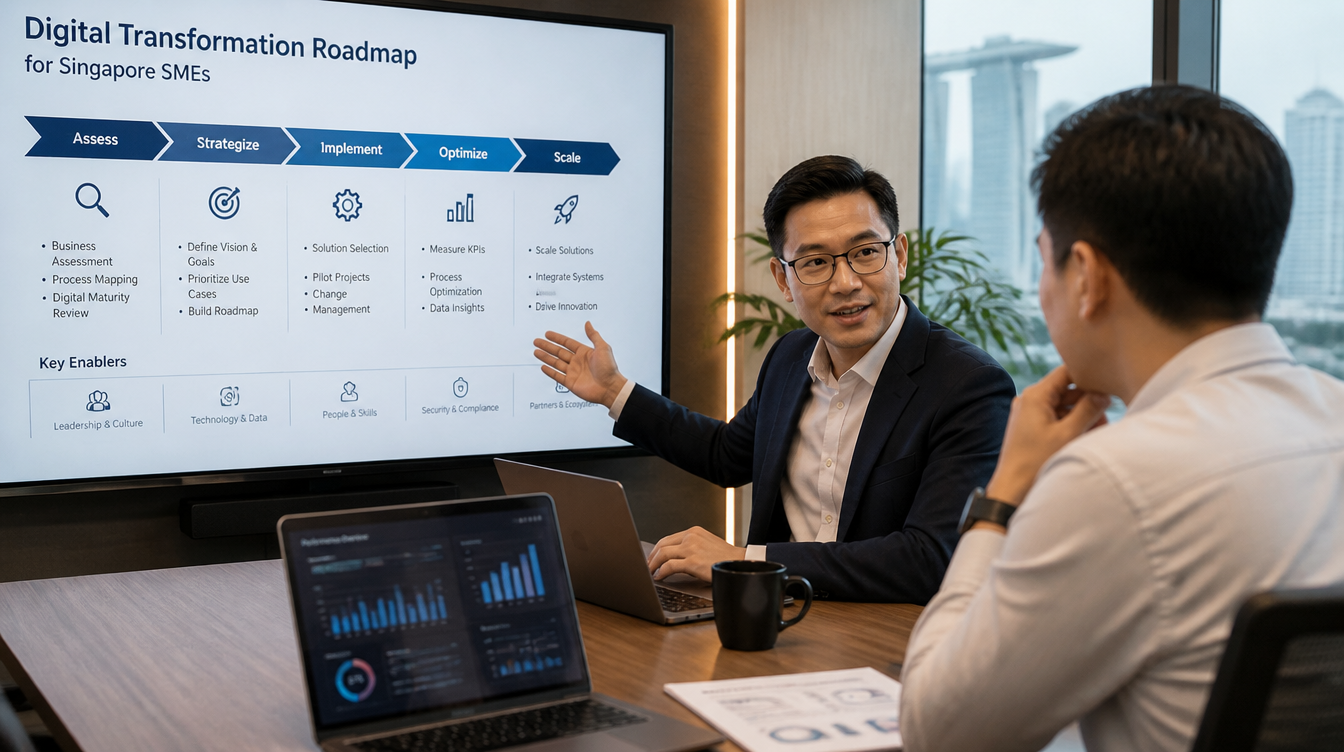
Here is how this works in practice. The senior consultant serves as your strategic lead, EDG-grant qualified external consultant, and primary accountability point. When the project requires specialist capacity (a data engineer to build a pipeline, a UX designer to prototype the staff-facing interface, a trainer to run AI literacy workshops across your team) the consultant brings in trusted specialists for those phases. The budget goes to the right skill at the right moment, rather than paying for a full agency team throughout the project.
This model has three specific advantages for Singapore SMEs:
Grant compatibility. EDG and CTC grants are tied to the qualifying consultant. The hybrid model preserves this. The consultant remains the grant-eligible external party; specialist sub-contractors are scoped as deliverables within the engagement.
Cost efficiency. You pay for a data engineer for the four weeks they are actually needed, not for twelve months of retaining an agency that keeps them available. At Singapore SME project scales (typically S$15,000 to S$60,000), this efficiency is significant.
Strategic continuity. When the same person who diagnosed your problem is also supervising the implementation and conducting the post-project review, nothing gets lost in handoff. You are not explaining your business context to a new project manager every quarter.
The hybrid model requires a consultant who has the network and the credibility to bring in good specialists, and the professional maturity to know when they need to. It is not the right answer if your consultant does not have that network, or if the project scope genuinely exceeds what one strategic lead can oversee.
Cost Comparison: What Each Option Costs and What Singapore Grants Cover
Understanding the true cost of each option, after grants, is essential for making this decision rationally. The sticker price is often misleading.
Solo AI consultant pricing in Singapore (2026):
Project-based engagements typically range from S$3,000 for a focused AI readiness assessment to S$30,000 for a full implementation project including roadmap, build oversight, vendor selection, and knowledge transfer. Ongoing advisory retainers typically run S$3,000 to S$8,000 per month, depending on the scope and seniority of the consultant.
Senior PMC-certified consultants command a premium: typically S$1,500 to S$3,500 per day for project work, or S$250 to S$500 per hour for advisory. This is consistent with EnterpriseSG's qualifying cost guidelines for EDG-funded engagements.
AI agency pricing in Singapore (2026):
Agency project fees are significantly higher, reflecting team overhead, business development costs, and margin across multiple roles. A mid-tier AI agency in Singapore will typically quote S$15,000 to S$50,000 for a contained implementation project and S$50,000 to S$150,000+ for a large-scale deployment. Monthly retainers for ongoing work start at S$5,000 and frequently exceed S$20,000 for comprehensive managed services.
Some agencies quote aggressively low project fees and then charge for change requests, additional integrations, and support. Get a fixed-scope quote and ask what happens when scope changes.
How EDG changes the maths:
EnterpriseSG's EDG grant covers up to 50% of qualifying project costs, subject to a project cap and the business meeting eligibility requirements (incorporated in Singapore, 30% local shareholding, core business activity in Singapore). The grant is applied as a co-funding reimbursement. You pay the full fee, then claim back the supported portion.
For a PMC-certified consultant engagement of S$30,000: EDG co-funds up to S$15,000, making your net cost S$15,000.
For an agency engagement of S$50,000 where the agency qualifies as an EDG external consultant: EDG co-funds up to S$25,000, net cost S$25,000.
The key word is "qualifies." Not all agencies are EDG-eligible external consultants. You need to verify this before signing. Check the EDG grant details and qualifying criteria here.
Other grants to layer:
MOM's Productivity Solutions Grant (PSG) covers pre-approved software solutions, relevant if the agency is implementing a PSG-listed AI tool. IMDA's CTC (Chief Technology Conversion) grant supports tech talent development. CTC is worth considering if your engagement includes staff AI training. These grants can be stacked under specific conditions, a qualified consultant will navigate this for you; agencies vary in their grant expertise.
There is a more detailed breakdown of pricing and grant interaction in my article on AI consultant fees in Singapore 2026.
How to Evaluate Both Options Using the Same Framework
Whether you are talking to a solo consultant or an agency, the evaluation framework is the same. Do not let either party control the evaluation criteria, run your own.
Step 1: Define your scope clearly before any conversation.
Write down, in plain English, what you are trying to accomplish. Not "implement AI", that is not a scope. "Automate the manual matching of incoming purchase orders against our supplier catalogue, currently done by three staff members, to reduce processing time from two days to two hours", that is a scope. With a defined scope, you can compare quotes meaningfully. Without it, you are comparing apples to PowerPoint slides.
Step 2: Assess your five situational factors.
- Scope complexity: Single workflow or multiple? One department or organisation-wide?
- Timeline: How much urgency do you actually have? Is the deadline real or artificial?
- Budget: What is the total envelope before grants? What is after grants if you qualify?
- Internal technical capacity: Do you have someone internally who can own the output once delivered?
- Grant eligibility: Have you verified your EDG/PSG eligibility and the vendor's qualifying status?
Map your answers honestly against the "when solo wins" and "when agency wins" criteria from the sections above.
Step 3: Ask for references you can actually call.
Not case studies. Not LinkedIn testimonials. Names and phone numbers of clients from comparable Singapore industries who engaged the consultant or agency for a comparable scope in the last two years. Call them. Ask three questions: Did the project deliver what was promised? Was the timeline and budget accurate? Would you engage them again?
Step 4: Scrutinise the deliverable list, not the narrative.
Proposals and decks are marketing. The deliverable list is the contract. Read it carefully. What exactly will you receive at the end of the engagement? What does success look like in measurable terms? If the proposal is heavy on vision and light on specific outputs, that is a red flag for both consultants and agencies.
Step 5: Understand the post-engagement model.
When the project ends, who maintains and updates the AI systems? What happens when something breaks? Who trains new staff? These questions separate consultants and agencies significantly. A consultant will typically train your team to own the system and charge for additional engagements. An agency may build maintenance into a recurring contract. Neither is wrong, but you need to know which model you are entering before you sign.
Questions to Ask Both a Consultant and an Agency Before Deciding
These questions work for both options. The quality of the answers will tell you more than any brochure.
Questions about experience and track record:
- Can you name three Singapore SMEs in my industry sector that you have worked with in the last two years? Can I contact them directly?
- What is the most common reason AI projects fail for businesses like mine? What do you do differently to prevent it?
- Have you done projects of similar scope and budget to mine? What were the outcomes?
Questions about the EDG grant and qualifying status:
- Are you a qualified external consultant for EnterpriseSG EDG applications? What is your PMC number or equivalent qualification?
- Have you co-managed EDG grant applications before? What is your success rate?
- Will you handle the grant application and reporting, or is that on us?
Questions about the process:
- Walk me through exactly what happens in the first 30 days of our engagement. Who does what?
- If the project scope changes, what is the process and cost impact?
- Who is the single point of accountability if something goes wrong?
Questions about the end state:
- What does our internal team need to know how to do at the end of this engagement?
- What is your plan for knowledge transfer and staff training?
- What ongoing support do you offer, and what does it cost?
The question most SMEs forget to ask:
What will you tell me if you think we do not need what we asked for? A consultant or agency that cannot answer this question credibly, or that has never told a client their planned project was the wrong move, has a conflict of interest you should factor into your decision.
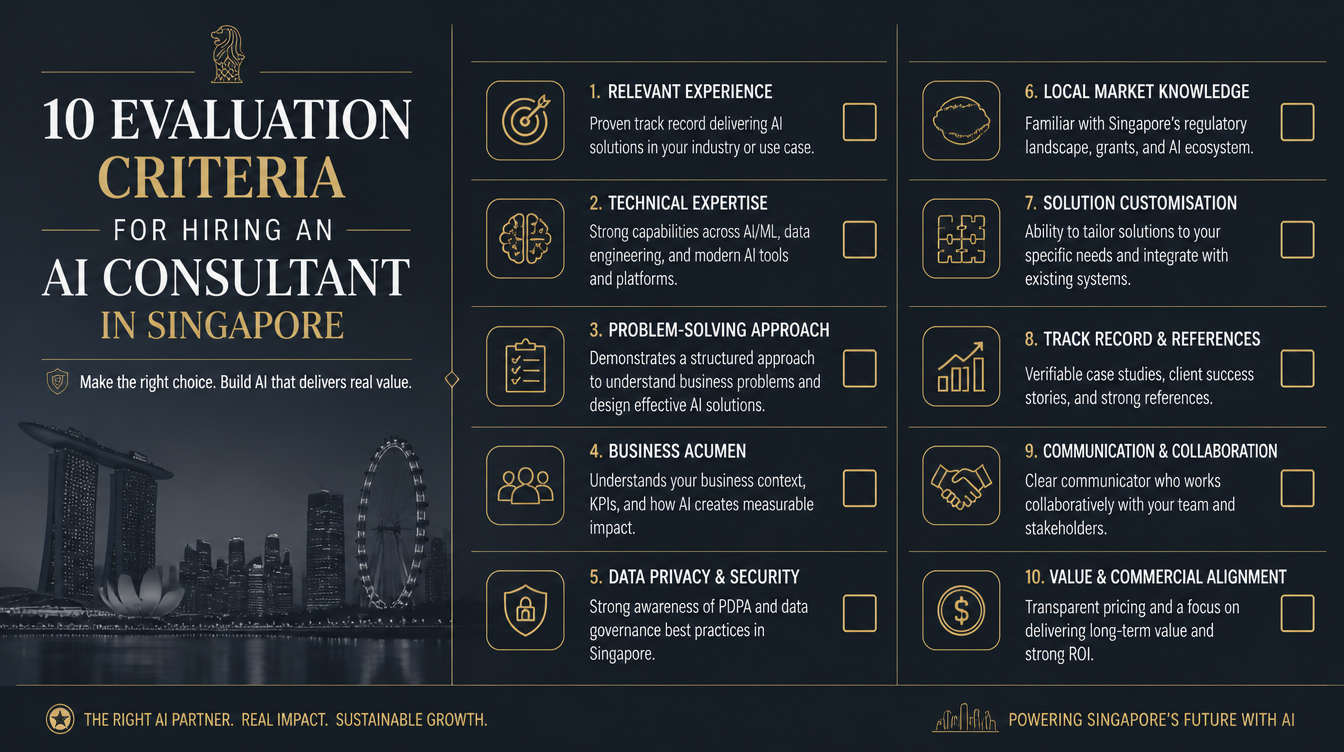
You can find a fuller checklist for evaluating AI consultants specifically in my guide on hiring an AI consultant in Singapore.
The Most Common Mistake Singapore SMEs Make When Choosing
The most common mistake is choosing an AI agency because it looks more professional than a solo consultant, then spending three times the budget for a solution that required one-third of the complexity.
I see this pattern repeatedly in the Singapore market. A business owner gets three quotes: one from a solo consultant for S$18,000, one from a boutique AI agency for S$45,000, and one from a larger agency for S$80,000. The solo consultant's proposal looks thinner on paper, one person, fewer slides, less jargon. The larger agency's proposal has a team org chart, a project management methodology diagram, and a phased roadmap with milestones. It looks serious. It looks safe.
The business chooses the S$45,000 agency. Eighteen months later, they have spent S$72,000 (the original fee plus change requests and a support retainer), and the system is being maintained by a junior from the agency who was not involved in the original build.
This is not an argument against agencies. It is an argument against choosing on the basis of how professional the proposal looks rather than whether the scope actually requires what the agency is selling.
The professionalism illusion
Agency proposals are marketing documents. They are designed to establish credibility and justify the fee. A solo consultant's proposal is often more direct, here is what I will do, here is what it costs, here are three people you can call who have worked with me. That directness reads as less polished to some buyers. It is actually a signal of confidence and track record.
The accountability gap
When you hire an agency, accountability is distributed across a team. If the project fails, there is no single person to point to, the project manager blames scope creep, the technical lead blames unclear requirements, the account manager apologises. When you hire a solo consultant, accountability is singular. They either delivered or they did not. That concentration of risk means a good solo consultant is very careful about what they commit to.
The grant waste
Choosing an agency that turns out not to be EDG-eligible is a common and expensive mistake. The business signs a contract assuming EDG will cover 50%, then learns the agency is not a qualifying consultant, and ends up absorbing the full fee. This is avoidable. Always verify EDG eligibility before signing, not after.
The scope inflation trap
Agencies have a structural incentive to expand scope. More scope means more team hours means more revenue. This is not malicious. It is how their business model works. A solo consultant has a weaker incentive to inflate scope: their bottleneck is time, and taking on a larger project than they can handle is a reputational risk. Ask directly: what is the minimum viable engagement to achieve my goal? A solo consultant will usually give you an honest answer. An agency's minimum viable engagement tends to look a lot like their standard package.
How to avoid the mistake:
Match scope to structure. If your project is genuinely complex (multiple departments, custom software, compressed timeline, no internal technical capacity) the agency may be right. If your project is a defined automation or an AI advisory engagement, run the numbers on the solo consultant option first, including the grant differential. Then decide.
You can explore the full range of AI services and how they map to different business situations at /ai-solutions.
Common questions
What is the main difference between an AI consultant and an AI agency in Singapore? A solo AI consultant is a single expert practitioner who takes full strategic and delivery accountability for your AI engagement. An AI agency is a structured commercial team (typically combining project managers, data engineers, developers, and UX specialists) operating under one brand. The difference is not just headcount: it is how accountability, expertise depth, and commercial incentives are structured. A consultant's incentive is aligned with your outcome; an agency's incentive includes retaining and growing your account.
When should a Singapore SME choose a solo AI consultant over an agency? Choose a solo AI consultant when you are in early-stage AI adoption and need strategic clarity before technical build, when your scope involves one or two workflows rather than organisation-wide transformation, when you want to use EDG grants and need a PMC-certified external consultant to qualify, or when you value deep domain expertise and a single point of accountability over team breadth. Most Singapore SMEs in the 10 to 100 employee range fall into this category.
Is a solo AI consultant eligible for EnterpriseSG EDG grants? Yes, in fact, PMC-certified solo AI consultants are often better positioned for EDG eligibility than agencies. The EDG requires the external consultant to meet EnterpriseSG's qualification criteria. PMC certification (Professional Membership Certification, awarded under the IMDA framework) is one of the recognised qualifying credentials. Not all AI agencies have this certification. Always verify grant eligibility with the specific consultant or agency before signing, not after.
What does an AI agency in Singapore typically cost compared to a solo consultant? Solo AI consultants in Singapore typically charge S$3,000-S$30,000 for project-based work and S$3,000-S$8,000 per month for ongoing advisory. AI agencies typically quote S$15,000-S$50,000 for contained implementation projects and can reach S$150,000+ for large-scale deployments, with ongoing retainers starting at S$5,000 per month. After EDG co-funding of up to 50%, a S$30,000 consultant engagement may cost S$15,000 net, comparable to what an agency charges before grants are factored in.
Can a solo AI consultant handle a large or complex AI project? Many senior solo consultants operate a hybrid model, they serve as the strategic lead and EDG-qualified consultant while bringing in trusted specialists (data engineers, trainers, UX designers) for specific phases. This model handles significant scope while preserving grant eligibility and strategic continuity. The limit for a pure solo engagement is typically projects that require more than two or three workstreams running simultaneously, at that point, a well-structured hybrid or full agency makes more practical sense.
How do I verify whether an AI agency is EDG-eligible in Singapore? Ask the agency directly for their qualifying external consultant's PMC number or equivalent EnterpriseSG-recognised credential. Then verify with EnterpriseSG directly or through your account manager at EnterpriseSG's Business Centre. Do this before signing any contract. Agencies sometimes overstate their grant eligibility during the sales process; the risk of assuming eligibility without verification falls on you as the applicant business.
What should I look for when comparing proposals from a consultant and an agency? Compare the deliverable list, not the narrative. What specific outputs will you receive? What does success look like in measurable terms? Ignore the quality of the slide deck. It is a marketing document. Ask for references you can call directly. Ask who owns accountability if the project fails. Ask what the minimum viable engagement is to achieve your goal. And always check EDG eligibility before the proposal stage, not at contract signing.
What is the hybrid consultant model and is it right for Singapore SMEs? The hybrid model places a senior solo consultant as your strategic lead and EDG-qualifying external consultant, while specialist sub-contractors are brought in for specific technical phases as needed. It combines the accountability and grant eligibility of a solo engagement with targeted specialist depth. For Singapore SMEs with budgets of S$20,000 to S$60,000 and defined but moderately complex scope, it is often the most cost-effective structure. The key requirement is that the lead consultant has a credible specialist network and the experience to manage them well.
How long do AI implementation projects typically take in Singapore? A focused AI automation project (one workflow, one department) typically takes 8-16 weeks from kickoff to handover, including the discovery phase, build or configuration, testing, and staff training. Organisation-wide deployments through an agency can take 6-18 months. EDG grant applications add 4-8 weeks to the timeline before the project can formally commence (the grant application must be submitted and approved before qualifying costs are incurred). Build this into your planning.
What questions should I never forget to ask before hiring either a consultant or an agency? The question most SMEs skip: "Have you ever told a client that their planned AI project was the wrong move, and what did you recommend instead?" Any consultant or agency that cannot give you a specific, honest example of this has a conflict of interest worth factoring in. A trustworthy AI advisor's job is to maximise your outcome, not their revenue. The ability to say "you do not need what you think you need" is a mark of genuine expertise, not a sales risk.
Related reading
Stay sharp
The weekly Singapore grant playbook.
Operator-grade pieces on PSG, EDG, CTC, MRA and the rest of the stack, straight to your inbox once a week. No spam, no upsell.
One email a week. Unsubscribe in one click.
Keep reading
AI Business Consultant Singapore: What They Do, What to Pay + How to Hire Right (2026)
What an AI business consultant actually does, how they differ from AI agencies, why PMC certification matters for EDG grants, and how PSG/EDG/CTC can fund your engagement.
13 min read
AI ConsultingAI Consultant Fees in Singapore: The Honest Breakdown for 2026
AI consultant fees in Singapore range from S$3,000 to S$100,000 per engagement. This is the honest breakdown of what each tier delivers and how grants can reduce your cost by up to 50%.
16 min read
AI TransformationWhat Does an AI Consultant Actually Do in Singapore?
An AI consultant in Singapore does far more than recommend ChatGPT. Here is the honest breakdown of deliverables, methodology, and what to expect from an engagement.
19 min read