PMC-Certified AI Consultant Singapore: Why Your Consultant's Credentials Actually Matter
In Singapore, PMC certification is not just a badge — it determines whether your business qualifies for EDG grants. Here is what PMC-certified AI consultants offer that others cannot.
Nick Tung
@nick_tung_ · 17 min read
Published:
Updated:
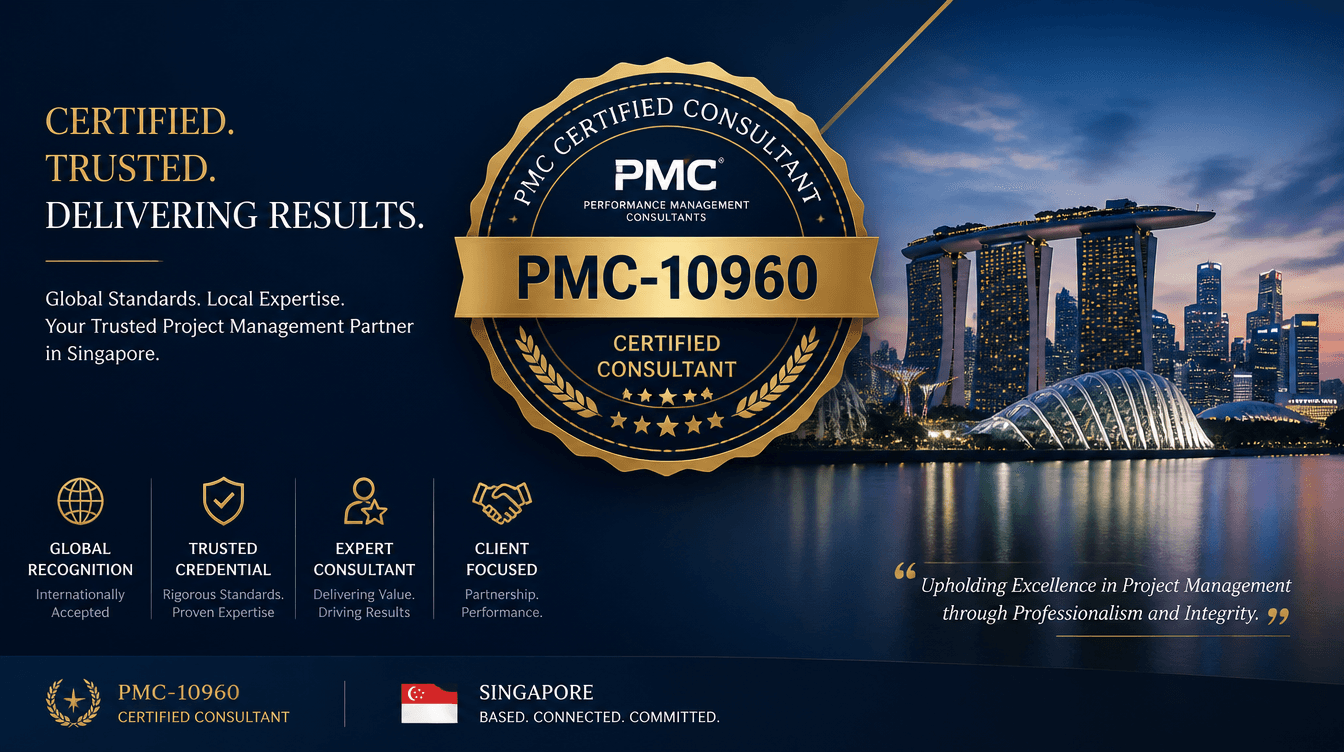
In Singapore, PMC certification is not just a badge. It determines whether your business qualifies for EDG grants. Here is what PMC-certified AI consultants offer that others cannot.
If you have spent any time researching AI consultants in Singapore, you have probably encountered the phrase "government-approved" or "EDG-eligible" on somebody's website. What most business owners do not realise is that these labels mean almost nothing without one specific credential: PMC certification issued by SBACC.
I hold PMC registration number SPMC-10960. That number is public, verifiable in under two minutes, and the reason why the SMEs I work with can use their Enterprise Development Grant to fund an AI transformation project rather than paying the full cost out of pocket. Over the past few years working with more than 1,000 Singapore SMEs across manufacturing, professional services, retail, and logistics, I have watched business owners hand five-figure fees to consultants who turned out to be completely ineligible for EDG funding. The damage is not just financial. The wasted months, the botched implementations, the projects that had to start from scratch. Those costs are real and they compound.
This article is a practitioner's account of what PMC certification actually means, how to verify it, and why it should be one of your first screening criteria when hiring any AI consultant in Singapore.
What PMC Certification Actually Is: And Who Issues It in Singapore
PMC certification (Practising Management Consultant) is SBACC's national certification scheme for management consultants. It signals that the certified consultant has met a defined standard of professional competency recognised by the Singapore government, and it is administered by the Singapore Business Advisors and Consultants Council (SBACC) under the Enterprise Singapore framework.
This is not a self-declared credential. It is not a LinkedIn badge or a vendor certification from a technology company. To receive PMC registration, a consultant must demonstrate relevant academic qualifications (typically a degree or higher), a minimum number of years of substantive consulting experience, and pass a structured assessment process. SBACC also requires ongoing professional development and compliance with a published code of ethics. The registration number assigned, mine is SPMC-10960, is tied to the individual consultant, not to the consulting firm, and it is maintained in a searchable government directory under my full legal name, Tung Kai Sheng, where it appears as PMC-10960, the code I held before my upgrade to Senior PMC.
The reason this matters to business owners specifically is that Enterprise Singapore uses PMC status as one of the primary eligibility gates for consultants participating in funded programmes. When a business engages a PMC-certified consultant for a qualifying scope of work, they gain access to government co-funding. When they engage a non-PMC consultant for the same scope of work, they are paying full price and often do not find out until after the contract is signed.
How the SBACC Manages the PMC Registry
SBACC, the Singapore Business Advisors and Consultants Council, is the professional body that maintains the PMC register on behalf of Enterprise Singapore. They handle applications, assessments, renewals, and the disciplinary process. This means there is an external organisation with a published code of professional conduct that PMC consultants are accountable to. A client who has a substantive complaint against a PMC consultant has a formal escalation path. A client who has a complaint against a non-PMC consultant has very few options beyond civil litigation.
The PMC scheme also distinguishes between individual registrations and firm registrations. A consulting firm may be a registered PMC Firm (PMCF), but the individual consultants delivering work must hold their own PMC numbers. When evaluating a consultant, always ask for the individual's PMC number, not just the firm's accreditation status.
PMC in the Context of Singapore's Broader Credentialing Ecosystem
Singapore has a mature ecosystem of professional credentialing, and PMC fits alongside other formal schemes like those administered by MOM (for employment practices advisors), IMDA (for digital transformation specialists), and the various professional bodies for accounting, law, and engineering. What distinguishes PMC is its direct connection to grant eligibility. IMDA's digital advisory schemes have their own approved panels, and there is some overlap, but for the broadest range of Enterprise Singapore-funded advisory work, including AI adoption under the EDG, PMC is the primary credential pathway.
Why PMC Status Directly Affects Your EDG Grant Eligibility
Your eligibility for EDG funding depends on PMC certification because Enterprise Singapore's grant framework explicitly requires third-party consultants to be qualified advisors. For management consulting and business advisory services (which includes AI strategy, AI implementation planning, and workforce transformation) the consultant must meet Enterprise Singapore's qualifying criteria, and PMC certification is the standard pathway for individual consultants to meet that bar.
Here is the financial reality. The Enterprise Development Grant covers up to 50% of qualifying project costs for most Singapore SMEs. For an AI transformation engagement priced at S$40,000, that means a potential co-funding amount of S$20,000, money that goes directly toward reducing your cash outlay. For projects in enhanced support categories or during periods of additional support (Enterprise Singapore has historically raised co-funding rates during economic stress periods), that percentage can be higher.
If your consultant is not PMC-certified and cannot demonstrate qualifying status through another Enterprise Singapore-approved pathway, the grant application will not succeed. You will have signed a contract, paid deposits, and committed management time to a project that cannot receive the funding you budgeted for.
What "Qualifying Third-Party Consultant" Actually Means
Enterprise Singapore's language around "qualifying third-party consultant" is worth unpacking. The phrase appears in EDG application guidelines and refers to consultants who are independent of the applicant company (no related-party relationship), professionally qualified to deliver the proposed scope of work, and registered under an appropriate accreditation scheme.
For AI-specific work, this gets layered. An AI implementation project that involves technology procurement only (buying software licences, for example) is generally not a consulting-fee cost that EDG funds. But an AI transformation project that involves strategic assessment, workflow redesign, staff training plans, and change management has a legitimate consulting component, and that is where PMC certification unlocks access to EDG co-funding for the advisory fees.
I have seen proposals structured incorrectly so that the bulk of the cost was classified as software rather than consulting, which eliminated most of the fundable amount. Getting the scope of work structured correctly, both for grant eligibility and for genuine delivery, is part of what a PMC consultant should know how to do.
The Grant Math in Practice
Let me be concrete. A typical AI transformation engagement for a Singapore SME (covering current-state assessment, AI readiness audit, technology selection, implementation roadmap, and change management planning) might be priced at S$30,000 to S$60,000 for a substantive engagement. At 50% co-funding, the net cost to the business is S$15,000 to S$30,000. At 70% (which was available during enhanced support periods), the net cost drops to S$9,000 to S$18,000.
These are not trivial differences. For an SME with 20 to 50 employees where every dollar of capital expenditure is scrutinised, the difference between 50% and 0% co-funding determines whether the project happens at all. PMC certification is not an administrative detail. It is the mechanism that makes serious AI transformation financially accessible to the companies that need it most.
You can read more about how EDG grant mechanics interact with AI consulting fees in my article on AI consultant fees in Singapore for 2026, and the full grant overview is at our EDG grants page.
How PMC Consultants Are Trained and Assessed by Enterprise Singapore
PMC-certified consultants are not assessed on a single exam. The certification process evaluates both formal qualifications and demonstrated consulting competency across several domains.
The core competency framework for PMC covers strategic analysis and diagnosis, business model innovation, change management, project management, professional ethics, and client relationship management. For an AI consultant, this means that someone holding a PMC credential has been assessed not just on technical knowledge but on their ability to manage a consulting engagement from scoping through delivery, which is a very different skill set from knowing how AI models work.
Academic Qualification Requirements
The entry bar for PMC requires, at minimum, a recognised degree. The typical profile of a PMC consultant in Singapore is someone with a degree in business, engineering, computer science, or a related field, with several years of substantive industry or consulting experience after graduation. For consultants whose primary credential is a postgraduate degree, the experience threshold may be lower.
This matters for AI consulting specifically because the Singapore market is now crowded with "AI trainers" and "AI coaches" who deliver workshops but have never managed a transformation project with accountable deliverables. The PMC framework requires demonstrated experience in consulting, not just technical fluency or the ability to explain concepts.
The Assessment Process
SBACC's assessment process for PMC involves documentation of past engagements, referee verification, and a formal panel review. It is not a pay-to-play certification. A consultant cannot simply purchase their way to PMC status through a fee and a short course. The rigour here is meaningful because it means that when you engage a PMC consultant, you have some assurance that at least one independent body has evaluated their track record and found it credible.
The renewal requirement, PMC certification must be maintained with ongoing professional development, also ensures that certified consultants are not static. A PMC consultant who earned their certification in 2018 and has done no CPD since then would be out of compliance. This creates at least a structural incentive for consultants to stay current with developments in their field, including AI.
Why This Is Different From Vendor Certifications
Many consultants in the Singapore market hold certifications from technology vendors: Microsoft Certified, Google Cloud Partner, AWS Certified, and so on. These are legitimate technical credentials, but they are not professional management consulting credentials. A vendor certification tells you that a person passed a technical exam set by a company with a commercial interest in having many certified partners. A PMC credential tells you that an independent government-affiliated body assessed the consultant's professional competency and found them qualified to advise Singapore businesses on strategy and implementation.
Both matter. But they answer different questions. When you are hiring someone to advise your leadership team on which AI strategy to pursue and how to manage the organisational change that follows, the professional consulting credential is the more relevant one.
PMC-Certified vs. Non-PMC: The Real Differences in Accountability
The most significant practical difference between a PMC-certified consultant and a non-PMC consultant is not knowledge. It is accountability. A PMC consultant operates under SBACC's code of professional ethics. A non-PMC consultant operates under whatever terms are in their contract, and contract disputes in Singapore generally end up in civil litigation, which is expensive and slow.
SBACC's code covers conflicts of interest, confidentiality, competence, honesty in representing qualifications, and the obligation to act in the client's interest. These are not just aspirational statements. A PMC consultant who violates these provisions can face disciplinary action, suspension, or removal from the register. The threat of losing PMC status (and with it, the ability to work on Enterprise Singapore-funded projects) is a real professional consequence that creates genuine accountability.
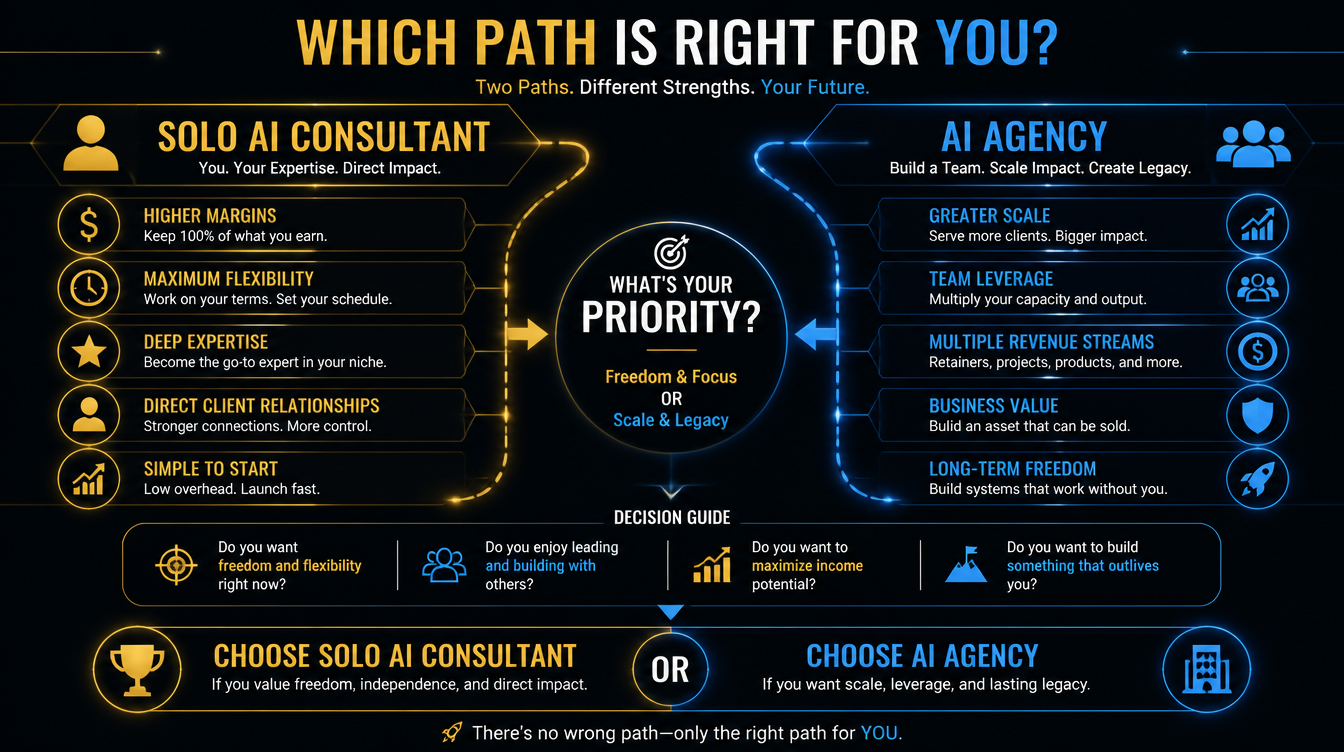
The Conflict-of-Interest Question
One of the more common accountability failures in AI consulting is undisclosed conflicts of interest. A consultant who recommends a specific AI platform and has a referral arrangement with that platform vendor is not giving independent advice. They are steering your technology decisions based on their financial interests. SBACC's code requires PMC consultants to disclose such arrangements.
This is especially important in AI consulting right now because the market is moving fast and there is significant commercial pressure on consultants to become "certified partners" of AI platform vendors. Being a certified partner of a technology company is not inherently wrong, but if it is not disclosed to a client who is paying for independent advisory services, it is a conflict of interest. PMC certification does not guarantee a consultant will always behave ethically, but it does create a formal accountability structure that non-PMC consulting lacks entirely.
What Happens When Things Go Wrong
In my experience working across more than 1,000 Singapore SMEs, AI projects go wrong most often in the change management phase, not the technology selection phase. The platform chosen is usually fine. The gap between what the technology can do and what the organisation is actually ready to do is where projects stall.
A PMC consultant who has been assessed on change management competency, and who knows that their professional registration is at stake if they misrepresent their capabilities, has a structural incentive to be honest about project risks. A non-PMC consultant who has no external accountability has a stronger incentive to promise what the client wants to hear in order to win the engagement.
This is not a moral judgement about any individual consultant. It is a statement about incentive structures. Accountability mechanisms matter because they shape behaviour, and PMC certification is one of the few external accountability mechanisms that exists for management consultants in Singapore.
How to Verify a Consultant's PMC Status (The Step-by-Step Process)
Verifying a consultant's PMC status takes approximately two minutes and should be a standard step in your vendor due diligence process. The registry is maintained by Enterprise Singapore and SBACC, and it is publicly accessible.
Here is the process:
Step 1. Go to www.enterprisesg.gov.sg and navigate to the section on consultants and advisors, or search directly for "PMC directory Singapore."
Step 2. Search by the consultant's name or, if they have provided it, their PMC number directly. My registration number is SPMC-10960.
Step 3. Confirm that the name in the directory matches the name on the consultant's business card or LinkedIn profile, that the registration status is active (not expired or suspended), and that the registration covers the scope of work you are proposing.
Step 4. If there is any discrepancy (the name does not match, the registration is lapsed, or the consultant claims a PMC number that does not appear in the directory) treat this as a serious red flag and ask for clarification before proceeding.
Why Consultants Who Are Genuinely PMC-Certified Are Happy to Share Their Number
A consultant who holds a valid PMC registration has no reason to withhold their number. The number is public. Asking for it is a reasonable due diligence step. If a consultant becomes evasive when asked for their PMC number, or claims that it is "in process" or "pending renewal", you should assume they do not have active certification and make your decision accordingly.
I include SPMC-10960 on my profile, my proposals, and my website. Transparency about verifiable credentials is basic professional honesty.
Cross-Referencing With Other Directories
For AI-specific work, you can also check whether a consultant appears in IMDA's directory of approved digital transformation advisors or has been accredited under any of IMDA's partner programs. These are separate from PMC but can be complementary signals of professional credibility. Cross-referencing two or three sources gives you more confidence than any single directory alone.
For grant-funded projects specifically, you can also ask the consultant to provide a letter of support from a Pilot Business Advisor or to walk you through the EDG application process before you sign. A consultant who has done this many times will be able to explain the process fluently. A consultant who is uncertain about the mechanics is a warning sign. See also our checklist for hiring an AI consultant in Singapore for the full due diligence framework.
AI-Specific PMC Consulting: What Qualifications Actually Signal
The PMC credential establishes professional consulting competency. For AI work specifically, you want to see that credential combined with real AI domain expertise, and those are two different things.
A consultant with PMC certification and ten years of experience in logistics process improvement but no substantive AI knowledge is not the right advisor for an AI transformation project. The PMC credential confirms their consulting process is sound; it does not guarantee AI-specific expertise. Similarly, a brilliant AI researcher with deep technical knowledge but no PMC certification cannot get your EDG grant application approved and may have little experience managing organisational change.
The intersection, PMC certification plus demonstrable AI expertise plus Singapore SME context, is the combination that actually delivers outcomes.
What AI Expertise Actually Looks Like
After working with more than 1,000 SMEs, I can tell you that "AI expertise" in a consulting context means being able to assess an organisation's specific readiness for AI adoption, identify the highest-leverage use cases given their existing data and processes, manage the procurement and integration of AI tools without overselling capabilities, design training programmes for staff who will use those tools, and measure outcomes in a way that connects AI implementation to business metrics rather than just technology metrics.
This is different from being able to explain how large language models work, or from having built AI applications as a software engineer. It requires a combination of technology fluency and change management experience that is genuinely uncommon, and it takes years to develop.
Signals of real AI consulting experience in a Singapore SME context include:
- Published case studies naming specific client organisations (with permission) and quantified outcomes
- Familiarity with IMDA's AI governance framework and ability to apply it to client projects
- Demonstrated experience with MOM's Fair Consideration Framework in the context of AI-driven workforce changes
- Understanding of Singapore's Personal Data Protection Act (PDPA) and how it applies to AI systems that process customer or employee data
- Practical knowledge of the technology stack that Singapore SMEs typically operate (accounting systems, HR systems, ERP systems) and where AI tools integrate with them
The IMDA AI Governance Framework
IMDA has published a comprehensive AI Governance Framework for Singapore organisations, and consultants advising on AI adoption should be familiar with it. The framework covers explainability, human oversight, accountability, data governance, and security. These are not abstract principles. They are the basis on which Singapore enterprises will be expected to govern their AI systems as regulatory attention to AI increases.
A PMC-certified AI consultant who understands both the grant landscape and the governance landscape can help an SME build AI capability that is both financially accessible and properly governed. That combination is considerably rarer than the marketing language in most consultants' LinkedIn summaries suggests.
You can read more about the specific services we offer at AI solutions for Singapore businesses.
Red Flags When a Consultant Claims PMC Without Verification
There is a spectrum of misrepresentation in the Singapore consulting market, and it ranges from honest confusion to deliberate fraud. Most cases I have encountered are in the middle: consultants who are genuinely uncertain about their own certification status, or who have let their registration lapse and have not updated their marketing materials.
The red flags to watch for are specific and verifiable.
"EDG-registered" without a PMC number. This phrasing is designed to sound like a specific government credential without actually claiming one. Enterprise Singapore does not have a generic "EDG-registered consultant" designation. The specific credential that makes a consultant eligible to deliver EDG-funded management consulting is PMC certification. Ask for the number.
"Government-approved" as a standalone claim. Similar to the above. Government approval for specific programmes is specific and verifiable. A vague "government-approved" label without citation of the exact programme and registration number is meaningless.
A PMC number that does not return results in the public directory. This is the clearest red flag. If a consultant provides a PMC number and that number does not appear in the Enterprise Singapore or SBACC directory, you have a problem. This could be because the registration has lapsed, because the number was transcribed incorrectly, or because it was fabricated. In any case, pause the engagement until it is resolved.
Reluctance to show you the EDG application process. A consultant who has successfully supported multiple EDG applications will be able to walk you through the process: the online portal, the required supporting documents, the typical timeline, the audit requirements after project completion. If a consultant becomes vague or evasive when you ask to understand the application process, it suggests they have limited real experience with it.
The "associate" arrangement. Some consulting firms maintain one PMC-certified person and staff projects with non-certified associates. The grant application is technically supported by the PMC consultant's credentials, but the person actually sitting in your meetings and doing the work may have no PMC certification at all. Ask directly: who will be on-site delivering the work, and what are their PMC numbers?
Beyond PMC: What Other Credentials Matter for AI Consulting in Singapore
PMC certification is necessary but not sufficient for AI consulting work. The Singapore market has several other credential frameworks that are worth understanding when you evaluate a consultant's background.
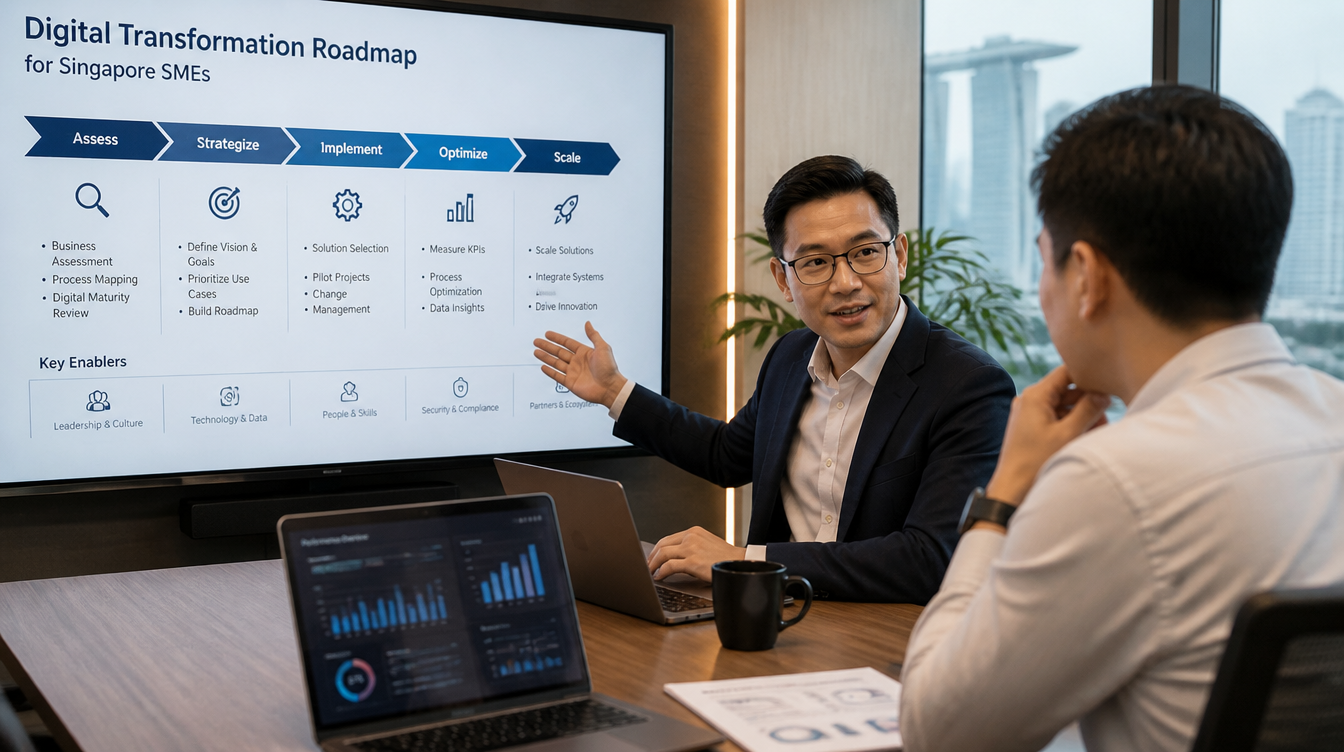
IMDA's Programmes and Digital Transformation Advisors
IMDA (the Infocomm Media Development Authority) has its own panel of approved advisors for specific digital transformation programmes. These include the SMEs Go Digital programme, various sector-specific digital roadmap initiatives, and AI-specific capability building programmes. Being on an IMDA approved panel is a separate credential from PMC, but it signals that IMDA has also assessed the consultant's capabilities in the digital transformation domain.
IMDA's AI governance training programmes are relevant because they ensure consultants are familiar with Singapore's policy approach to responsible AI. As AI regulation evolves, and it is evolving quickly, consultants who are current on IMDA's governance framework will be better positioned to advise clients in a way that reduces compliance risk.
Academic and Research Credentials
For AI work that involves genuine technical depth (custom model development, advanced data science, enterprise-scale AI architecture) academic credentials matter more than they do for standard AI adoption consulting. An AI consultant with a Master's or PhD in machine learning, data science, or computer science brings a different kind of expertise than a consultant with an MBA and a vendor certification.
The caveat is that academic credentials do not substitute for PMC certification where EDG grant access is concerned. A PhD in computer science does not make someone a qualifying third-party consultant for EDG purposes. Both types of credential are valuable, but they serve different functions.
Real Case Studies With Named Clients
This is perhaps the most important secondary credential: documented evidence of having done this work before with real Singapore organisations and quantified results. A consultant who can show you a case study (even anonymised, but with specific numbers and outcomes) is providing verifiable evidence of competency. A consultant who can only speak in general terms about AI capabilities and transformation frameworks has not been tested by actual delivery.
When I review case studies with prospective clients, I look for specificity: which sector, what was the baseline, what changed, how long did it take, what were the complications, and what happened with adoption six months after implementation. Vague success stories are not evidence. Specific, honest accounts of what worked and what had to be adjusted are the real signal.
The CTC and PSG Pathways
Beyond EDG, Singapore's Capability Transfer Programme (CTP) and Productivity Solutions Grant (PSG) also have consultant and vendor eligibility criteria. PSG specifically pre-approves certain technology solutions and the vendors who implement them. If your AI project involves adopting a specific tool that is on the PSG pre-approved solutions list, the relevant credential is the vendor's PSG approval, not necessarily the consultant's PMC status.
Understanding which grant is right for which type of AI project is itself a consulting competency. EDG is best suited for strategic, advisory, and transformational work. PSG is best suited for adopting specific pre-approved technology solutions. CTP is designed for transferring specific capabilities from overseas sources. A consultant who can help you think through which grant pathway fits your project, and who has the right credentials for that pathway, is far more useful than someone who generically claims to be "grant-eligible."
The Landscape Is Changing: And Credentials Matter More, Not Less
The AI consulting market in Singapore is experiencing the same dynamic that hits every market when a new technology creates a gold rush: the space between genuine expertise and marketing language is collapsing. In 2024 and 2025, the number of people describing themselves as "AI consultants" in Singapore grew dramatically. Most of them are not bad actors. Many of them are technically competent. But technical competency and professional consulting competency are different, and credentials are one of the few ways to separate them at the due diligence stage.
Enterprise Singapore has not accidentally made PMC certification a gate for EDG funding. They did it precisely because they want to ensure that public co-funding goes toward engagements delivered by consultants who meet a professional standard. That standard exists because the government has watched what happens when it does not, the money gets spent, the projects fail, and the SME is worse off than before.
As AI becomes more central to Singapore's economic strategy (IMDA's National AI Strategy 2.0, Enterprise Singapore's digitalisation push, MOM's workforce transformation agenda) the stakes of getting AI consulting right are rising. A failed AI implementation at an SME does not just cost the company money. It damages the workforce's confidence in digital transformation, strains relationships with government agencies, and in some cases creates data governance or compliance problems that outlast the original project.
PMC certification does not guarantee a successful project. Nothing does. But it is a structural guardrail that screens out a significant category of unqualified consultants, aligns incentives toward professional behaviour, and makes grant funding accessible in a way that genuinely expands what Singapore SMEs can afford to do. That is why it matters, and why it should be one of your first due diligence questions, not an afterthought.
If you would like to understand what a PMC-certified AI transformation engagement looks like in practice, or to verify SPMC-10960 before we have any further conversation, I encourage you to start there.
Common questions
What is a PMC-certified consultant in Singapore? A PMC-certified consultant (Practising Management Consultant) is a management consultant who has been accredited by the Singapore Business Advisors and Consultants Council (SBACC) under the Enterprise Singapore framework. The certification requires demonstrated academic qualifications, substantive consulting experience, and assessment by an independent panel. PMC certification is maintained through ongoing professional development and compliance with a published code of ethics.
Why does PMC certification matter for EDG grant applications? Enterprise Singapore's Enterprise Development Grant requires that third-party consultants delivering funded advisory services meet qualifying criteria, and PMC certification is the primary pathway for individual consultants to meet those criteria. Without a PMC-certified consultant (or a consultant qualifying through another approved route), an SME's EDG application for management consulting or business advisory services will not be approved. With the grant covering up to 50% of qualifying costs, this can mean the difference between a project being affordable or not.
How do I verify that a consultant is PMC-certified? Visit the Enterprise Singapore website (www.enterprisesg.gov.sg) and search the consultant directory using the consultant's name or their PMC registration number. The search takes approximately two minutes. Dr Nick Tung's registration number is SPMC-10960. Any PMC-certified consultant should be willing to provide their number and encourage you to verify it before engaging them.
What is the difference between PMC certification and vendor certifications like Microsoft or Google Cloud? Vendor certifications confirm that a consultant has passed a technical assessment set by a technology company. PMC certification confirms that an independent government-affiliated body has assessed the consultant's professional management consulting competency, including strategic analysis, change management, project management, and ethics. Both types of credential can be valuable, but they answer different questions, and PMC certification is what matters for EDG grant eligibility.
Can a non-PMC consultant deliver AI consulting work in Singapore? Yes, PMC certification is not required to work as a consultant in Singapore. It is required to be a qualifying third-party consultant for certain Enterprise Singapore-funded programmes, including EDG-funded management consulting. A non-PMC consultant can be technically excellent, but their clients will not be able to use EDG co-funding to pay for their advisory fees.
What does "up to 50% EDG co-funding" actually mean for an AI project? For most Singapore SMEs, Enterprise Singapore will co-fund up to 50% of qualifying project costs for EDG-approved engagements. On a S$40,000 AI transformation project, this means the government co-funds up to S$20,000, and the company pays the remaining S$20,000 net. The exact percentage depends on the company's profile, the project scope, and any enhanced support periods that may be in effect. The consultant's PMC status is a prerequisite for unlocking this co-funding for advisory fees.
What should I ask a consultant to prove their PMC status before signing a contract? Ask for their PMC registration number and verify it in the public directory. Ask them to walk you through the EDG application process, a consultant with genuine experience will know the portal, the required documentation, the typical review timeline, and the post-project audit requirements. Ask who specifically will be delivering the work and confirm that person's PMC status, not just the firm's. If you get evasion or uncertainty on any of these questions, treat it as a red flag.
Are there other credentials that matter for AI consulting in Singapore beyond PMC? Yes. For AI-specific work, look for familiarity with IMDA's AI Governance Framework and the National AI Strategy 2.0, experience with Singapore's PDPA as it applies to AI systems, knowledge of MOM's Fair Consideration Framework for AI-driven workforce changes, and verifiable case studies with Singapore organisations showing quantified outcomes. Academic credentials in machine learning, data science, or computer science are relevant for technically intensive projects. For PSG-funded technology adoption specifically, check whether the consultant or their recommended technology solution is on IMDA's pre-approved list.
Is Dr Nick Tung's PMC certification verifiable? Yes. SPMC-10960 is Dr Nick Tung's active registration number, issued through the SBACC under Enterprise Singapore's framework. It can be verified in the public consultant directory. Nick has been PMC-certified as an AI and workforce transformation consultant working primarily with Singapore SMEs across manufacturing, professional services, retail, and logistics, having worked with more than 1,000 companies in the market.
What is the SBACC and what role does it play in PMC certification? The Singapore Business Advisors and Consultants Council (SBACC) is the professional body that administers the PMC register on behalf of Enterprise Singapore. SBACC handles applications, assessments, renewals, and disciplinary matters for PMC-certified consultants. Their published code of professional ethics covers conflicts of interest, confidentiality, competence, and the obligation to act in the client's interest. PMC consultants who violate this code can face disciplinary action, including removal from the register, a meaningful professional consequence that creates real accountability.
Related reading
Stay sharp
The weekly Singapore grant playbook.
Operator-grade pieces on PSG, EDG, CTC, MRA and the rest of the stack, straight to your inbox once a week. No spam, no upsell.
One email a week. Unsubscribe in one click.
Keep reading
AI Business Consultant Singapore: What They Do, What to Pay + How to Hire Right (2026)
What an AI business consultant actually does, how they differ from AI agencies, why PMC certification matters for EDG grants, and how PSG/EDG/CTC can fund your engagement.
13 min read
AI ConsultingAI Consultant Fees in Singapore: The Honest Breakdown for 2026
AI consultant fees in Singapore range from S$3,000 to S$100,000 per engagement. This is the honest breakdown of what each tier delivers and how grants can reduce your cost by up to 50%.
16 min read
AI TransformationWhat Does an AI Consultant Actually Do in Singapore?
An AI consultant in Singapore does far more than recommend ChatGPT. Here is the honest breakdown of deliverables, methodology, and what to expect from an engagement.
19 min read